
|
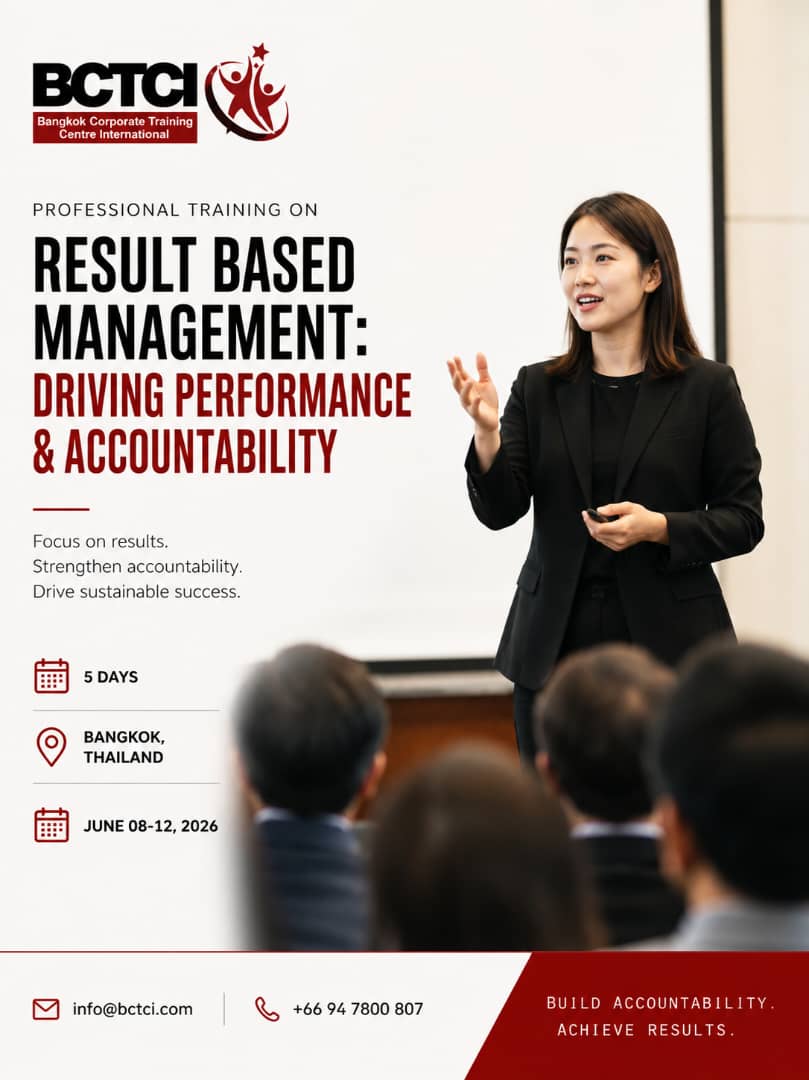
Course |
Result-Based Management: Driving Performance & Accountability |
|
Duration |
5 Days |
|
Date |
June 08-12, 2026 |
|
Venue |
Bangkok, Thailand |
|
Investment |
1,590 USD |
|
|
|
|
|
+66 94 7800 807 |
Course Objectives
By the end of this course, participants will be able to:
- Understand the principles, concepts, and importance of Result-Based Management.
- Link organizational goals, programs, projects, and activities to measurable results.
- Develop clear results chains, logical frameworks, indicators, baselines, and targets.
- Strengthen planning, implementation, monitoring, evaluation, and reporting systems.
- Improve accountability by connecting resources, activities, outputs, outcomes, and impacts.
- Apply RBM tools to improve project and program performance.
- Use evidence and performance data for decision-making.
- Design practical monitoring and evaluation systems aligned with results.
- Improve reporting quality for management, donors, stakeholders, and beneficiaries.
- Develop a practical RBM action plan for workplace application.
Personal and Organizational Impacts
Personal Impacts
Participants will be able to:
- Improve confidence in planning and managing results-focused programs.
- Strengthen skills in performance measurement and accountability.
- Develop better understanding of indicators, targets, baselines, and data use.
- Improve ability to prepare logical frameworks and results chains.
- Communicate project performance more clearly to management and stakeholders.
- Use evidence-based thinking in daily planning and decision-making.
- Improve reporting skills by focusing on results rather than activities.
- Support stronger project delivery and professional credibility.
Organizational Impacts
The organization will benefit through:
- Better alignment between strategy, programs, projects, and measurable results.
- Stronger accountability for performance, resources, and outcomes.
- Improved project planning, monitoring, evaluation, and reporting.
- Better use of data for management decisions.
- Improved donor, stakeholder, and beneficiary confidence.
- Clearer performance indicators and measurable targets.
- Reduced focus on activities only and increased focus on real outcomes.
- Stronger institutional learning and continuous improvement.
- Improved resource allocation based on evidence and performance.
- Better achievement of organizational and development objectives.
Course Outline:
Foundations of Result-Based Management
Module 1: Introduction to Result-Based Management
- Meaning and purpose of Result-Based Management
- Difference between activity-based management and result-based management
- Why RBM matters for performance and accountability
- Key RBM principles and concepts
- Common challenges in applying RBM
Module 2: Results Thinking and Performance Culture
- Building a results-oriented mindset
- Moving from “what we do” to “what we achieve”
- Creating a culture of performance and accountability
- Roles of leadership, teams, and stakeholders in RBM
- Linking individual performance to organizational results
Module 3: Understanding the Results Chain
- Inputs, activities, outputs, outcomes, and impact
- Cause-and-effect logic in programs and projects
- Short-term, medium-term, and long-term results
- Assumptions and external factors affecting results
- Common mistakes in developing results chains
Module 4: Strategic Alignment and Results Planning
- Linking RBM with organizational strategy
- Connecting national, sectoral, institutional, and project goals
- Aligning programs with stakeholder needs
- Translating strategy into measurable results
- Prioritizing results based on organizational mandate
Module 5: Stakeholder Analysis in RBM
- Identifying key stakeholders and beneficiaries
- Understanding stakeholder expectations
- Stakeholder influence, interest, and accountability
- Involving stakeholders in defining results
- Managing stakeholder communication and participation
Designing Results, Indicators, and Logical Frameworks
Module 6: Problem Analysis and Objective Setting
- Defining the core problem
- Problem tree analysis
- Objective tree development
- Converting problems into results statements
- Setting clear and achievable objectives
Module 7: Developing Results Statements
- Characteristics of strong results statements
- Difference between outputs, outcomes, and impacts
- Avoiding vague and activity-based wording
- Writing results using clear change language
- Testing results statements for clarity and measurability
Module 8: Performance Indicators
- Meaning and purpose of indicators
- Quantitative and qualitative indicators
- Output, outcome, and impact indicators
- SMART indicator design
- Common weaknesses in indicator development
Module 9: Baselines, Targets, and Milestones
- Understanding baselines
- Setting realistic and measurable targets
- Using milestones to track progress
- Target setting with limited data
- Reviewing and adjusting targets responsibly
Module 10: Logical Framework Approach
- Structure and purpose of the logical framework
- Results hierarchy in logframes
- Indicators, means of verification, and assumptions
- Linking logframes with implementation plans
- Reviewing logframes for quality and consistency
Monitoring, Evaluation, Data, and Evidence
Module 11: Monitoring Systems for Results
- Purpose of monitoring in RBM
- Designing a results-based monitoring system
- Monitoring outputs, outcomes, risks, and assumptions
- Roles and responsibilities in monitoring
- Monitoring frequency, tools, and reporting cycles
Module 12: Evaluation in Result-Based Management
- Purpose of evaluation in RBM
- Formative, mid-term, final, and impact evaluations
- Evaluation criteria: relevance, effectiveness, efficiency, impact, and sustainability
- Evaluation questions and scope
- Using evaluation findings for improvement
Module 13: Data Collection Methods
- Quantitative and qualitative data collection
- Surveys, interviews, focus groups, observation, and document review
- Selecting appropriate data sources
- Data collection tools and templates
- Ensuring reliability and consistency of data
Module 14: Data Quality Assurance
- Importance of data quality in RBM
- Accuracy, completeness, timeliness, validity, and reliability
- Data verification and validation
- Common data quality risks
- Data quality improvement actions
Module 15: Data Analysis and Performance Interpretation
- Turning data into useful information
- Comparing actual performance against targets
- Identifying trends, gaps, and performance issues
- Understanding reasons behind underperformance
- Using analysis for corrective action
Accountability, Reporting, Risk, and Learning
Module 16: Results-Based Reporting
- Difference between activity reporting and results reporting
- Structure of a results-based report
- Reporting progress against indicators and targets
- Explaining achievements, challenges, and lessons learned
- Writing concise and evidence-based performance narratives
Module 17: Accountability and Performance Responsibility
- Meaning of accountability in RBM
- Accountability for resources, actions, outputs, and outcomes
- Assigning responsibilities for results
- Performance agreements and responsibility matrices
- Strengthening accountability without creating blame culture
Module 18: Risk Management in RBM
- Identifying risks to results achievement
- Operational, financial, institutional, political, and external risks
- Risk rating and prioritization
- Risk mitigation planning
- Monitoring risks throughout the project cycle
Module 19: Learning and Adaptive Management
- Learning as a core element of RBM
- Using monitoring findings for improvement
- Adapting plans based on evidence
- Capturing lessons learned and good practices
- Building institutional memory and knowledge sharing
Module 20: Resource Allocation and Value for Money
- Linking resources to results
- Budgeting for outputs and outcomes
- Understanding economy, efficiency, effectiveness, and equity
- Tracking cost against results
- Improving value for money in programs and projects
Implementation, Performance Improvement, and Action Planning
Module 21: RBM Implementation Strategy
- Steps for introducing RBM in an organization
- Building leadership support for RBM
- Roles of planning, finance, M&E, and program teams
- Integrating RBM into existing systems
- Managing resistance to RBM implementation
Module 22: Performance Dashboards and Scorecards
- Purpose of dashboards and scorecards
- Selecting key performance indicators
- Designing simple performance dashboards
- Visualizing progress, trends, and gaps
- Using dashboards for management review meetings
Module 23: RBM in Projects, Programs, and Institutions
- Applying RBM at project level
- Applying RBM at program level
- Applying RBM at organizational level
- Aligning multiple projects under common results
- Managing results across departments and partners
Module 24: Common RBM Challenges and Practical Solutions
- Weak indicators and unclear results
- Limited baseline data
- Poor reporting and weak evidence
- Lack of ownership and accountability
- Practical solutions for sustainable RBM application
Module 25: Practical Workshop and RBM Action Plan
- Developing a results chain for a real project
- Preparing indicators, baselines, and targets
- Designing a simple monitoring framework
- Preparing a results-based reporting template
- Presenting an RBM improvement action plan
Main Takeaways
Participants will leave the course with:
- A practical understanding of Result-Based Management.
- Ability to develop results chains and logical frameworks.
- Improved skills in writing clear outputs, outcomes, and impact statements.
- Stronger ability to design indicators, baselines, targets, and milestones.
- Better understanding of monitoring and evaluation systems.
- Skills to collect, verify, analyze, and use performance data.
- Ability to prepare results-based reports.
- Stronger understanding of accountability and performance responsibility.
- Practical tools for improving value for money and resource alignment.
- A workplace-ready RBM action plan.
Main Essentials
The essential components of this course include:
- Results Thinking
Moving from activity completion to measurable performance and meaningful change. - Results Chain Development
Connecting inputs, activities, outputs, outcomes, and impact in a logical sequence. - Performance Indicators
Designing indicators that clearly measure progress and achievement. - Baselines and Targets
Setting reference points and measurable expectations for performance. - Logical Frameworks
Structuring project logic, indicators, verification sources, and assumptions. - Monitoring and Evaluation
Tracking progress, assessing performance, and learning from results. - Data Quality and Evidence
Ensuring decisions and reports are based on reliable information. - Results-Based Reporting
Communicating achievements, challenges, and lessons using evidence. - Accountability
Clarifying who is responsible for delivering results and improving performance. - Performance Improvement
Using RBM tools to strengthen planning, implementation, learning, and organizational impact.
Suggested Training Methodologies
The course may be delivered through:
- Interactive lectures and facilitated discussions
- Practical RBM case studies
- Problem tree and objective tree exercises
- Results chain development workshops
- Indicator design activities
- Logical framework preparation exercises
- Data quality assessment exercises
- Results-based reporting practice
- Group presentations and peer review
- Workplace action planning