
|
Course |
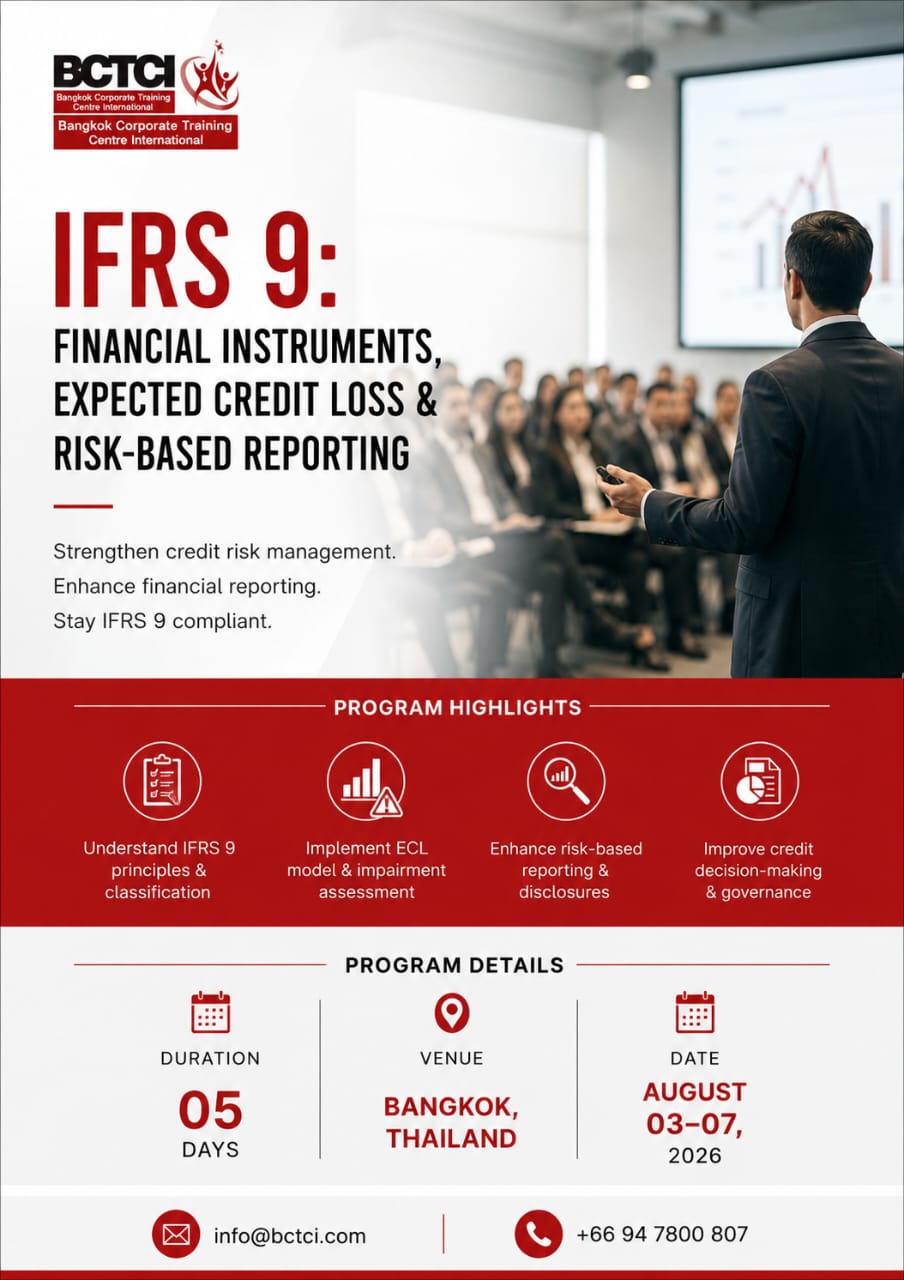
IFRS 9: Financial Instruments, Expected Credit Loss & Risk-Based Reporting |
|
Duration |
05 Days |
|
Date |
August 03-07,2026 |
|
Venue |
Bangkok, Thailand |
|
Investment |
1,890 USD |
|
|
|
|
|
+66 94 7800 807 |
Course Objectives:
By the end of this course, participants will be able to:
- Understand the core principles, structure, and scope of IFRS 9 Financial Instruments.
- Classify and measure financial assets and financial liabilities correctly.
- Apply the SPPI test and business model assessment for financial assets.
- Understand amortized cost, fair value through OCI, and fair value through profit or loss.
- Develop a practical understanding of the Expected Credit Loss model.
- Distinguish between Stage 1, Stage 2, and Stage 3 credit exposures.
- Apply 12-month ECL and lifetime ECL concepts.
- Understand the role of PD, LGD, EAD, discount rate, and forward-looking information.
- Assess significant increase in credit risk.
- Understand impairment requirements for loans, receivables, guarantees, and commitments.
- Improve IFRS 9 governance, documentation, controls, and audit readiness.
- Link IFRS 9 reporting with credit risk management, provisioning, capital planning, and regulatory expectations.
Personal and Organizational Impacts
Personal Impact
Participants will be able to:
- Strengthen their technical knowledge of IFRS 9.
- Interpret financial instruments more confidently.
- Improve decision-making in credit risk, finance, audit, and treasury functions.
- Understand impairment calculations and ECL reporting.
- Communicate IFRS 9 issues clearly with auditors, regulators, and senior management.
- Identify documentation gaps in classification, measurement, and impairment.
- Build confidence in reviewing IFRS 9 models, assumptions, and disclosures.
Organizational Impact
Organizations will benefit through:
- Improved IFRS 9 compliance and reporting quality.
- Stronger credit risk governance and provisioning practices.
- Better alignment between finance, risk, credit, audit, and treasury teams.
- More reliable impairment estimates and financial statements.
- Reduced audit findings and regulatory concerns.
- Stronger internal controls around financial instruments.
- Improved board and management reporting on credit risk and expected losses.
Training Methodologies / Strategies:
The course will use a practical and interactive approach, including:
- Instructor-led technical sessions
- Practical IFRS 9 examples and illustrations
- Banking and financial institution case studies
- Group discussions and scenario analysis
- Mini exercises on classification and measurement
- ECL calculation demonstrations
- Review of sample disclosures
- Risk governance mapping exercises
- Internal audit and compliance checklists
- End-of-course practical assessment
Main Takeaways:
Participants will leave the course with a strong understanding of:
- IFRS 9 structure and key requirements
- Classification and measurement of financial assets
- Financial liability accounting under IFRS 9
- SPPI test and business model assessment
- Fair value and amortized cost measurement
- Expected Credit Loss methodology
- Stage 1, Stage 2, and Stage 3 impairment
- PD, LGD, EAD, and forward-looking assumptions
- Significant increase in credit risk
- Loan impairment and provisioning under IFRS 9
- Hedge accounting overview
- IFRS 9 disclosure expectations
- IFRS 9 governance, control, and audit readiness
Course Essentials
This course is essential for organizations that want to:
- Improve IFRS 9 implementation quality
- Strengthen impairment and provisioning processes
- Ensure accurate classification of financial instruments
- Build stronger coordination between risk and finance
- Prepare for audit, regulatory review, and board reporting
- Improve transparency in credit risk and financial reporting
- Reduce errors in financial statements and disclosures
Course Outline:
IFRS 9 Framework, Scope, Classification & Measurement
Module 1: Introduction to IFRS 9 Financial Instruments
- Overview of IFRS 9 and its purpose
- Difference between IAS 39 and IFRS 9
- Why IFRS 9 was introduced
- Key pillars of IFRS 9:
- Classification and measurement
- Impairment
- Hedge accounting
- Relevance of IFRS 9 for banks and financial institutions
- IFRS 9 impact on financial statements
Practical Focus:
Participants will discuss how IFRS 9 affects lending, investment, treasury, and risk management activities.
Module 2: Scope of IFRS 9 and Financial Instruments
- What is a financial instrument?
- Financial assets
- Financial liabilities
- Equity instruments
- Loans and advances
- Trade receivables
- Debt securities
- Equity investments
- Derivatives
- Financial guarantees
- Loan commitments
- Items outside the scope of IFRS 9
Practical Focus
Participants will classify common balance sheet items into financial assets, financial liabilities, and non-financial items.
Module 3: Classification of Financial Assets
- IFRS 9 classification categories:
- Amortized cost
- Fair Value Through Other Comprehensive Income
- Fair Value Through Profit or Loss
- Business model assessment
- Contractual cash flow characteristics
- Role of management intention
- Reclassification rules
- Documentation requirements
Practical Focus:
Participants will analyze sample financial assets and determine their correct classification.
Module 4: Business Model Assessment
- Hold to collect business model
- Hold to collect and sell business model
- Other business models
- Role of portfolio management
- Frequency and significance of sales
- Management reporting evidence
- Stress sales and liquidity sales
- Governance over business model documentation
Practical Focus
Participants will evaluate different loan and investment portfolios and determine the relevant business model.
Module 5: SPPI Test and Contractual Cash Flow Assessment
- Meaning of Solely Payments of Principal and Interest
- Understanding principal
- Understanding interest
- Time value of money
- Credit risk compensation
- Liquidity risk and profit margin
- Modified time value of money
- Prepayment features
- Extension options
- Non-recourse features
- Contractually linked instruments
Practical Focus
Participants will perform SPPI assessments on sample loan and investment instruments.
Measurement, Fair Value, Liabilities & Derecognition
Module 6: Amortized Cost Measurement
Key Topics
- Meaning of amortized cost
- Effective Interest Rate method
- Initial recognition
- Transaction costs
- Interest income recognition
- Premiums and discounts
- Changes in estimated cash flows
- Practical challenges in amortized cost calculation
Practical Focus
Participants will review a simple loan amortization example using the effective interest method.
Module 7: Fair Value Through OCI and Fair Value Through Profit or Loss
- FVOCI for debt instruments
- FVOCI election for equity instruments
- FVTPL classification
- Accounting treatment for fair value gains and losses
- Recycling and non-recycling of gains
- Dividend income treatment
- Implications for profit volatility
- Practical reporting considerations
Practical Focus
Participants will compare how the same investment may affect profit or loss and OCI under different classifications.
Module 8: Financial Liabilities under IFRS 9
- Classification of financial liabilities
- Amortized cost for liabilities
- Fair value option
- Own credit risk treatment
- Loan borrowings
- Deposits from customers
- Debt securities issued
- Subordinated debt
- Modification of financial liabilities
Practical Focus
Participants will analyze accounting treatment for deposits, borrowings, and issued debt instruments.
Module 9: Derivatives and Embedded Derivatives
- Definition of derivatives
- Common derivative instruments
- Forward contracts
- Options and swaps
- Embedded derivatives in host contracts
- Separation requirements
- Fair value measurement of derivatives
- Derivative risk and financial reporting impact
Practical Focus
Participants will identify embedded derivative features in selected financial contracts.
Module 10: Derecognition and Modification of Financial Instruments
- Derecognition of financial assets
- Transfer of risks and rewards
- Continuing involvement
- Write-off of financial assets
- Loan restructuring
- Modification gain or loss
- Derecognition of financial liabilities
- Difference between modification and extinguishment
Practical Focus
Participants will review loan restructuring scenarios and determine the accounting treatment.
Expected Credit Loss Model and Impairment Framework
Module 11: Introduction to IFRS 9 Expected Credit Loss
- From incurred loss to expected loss
- Purpose of the ECL model
- Scope of impairment requirements
- Financial assets subject to impairment
- Loan commitments
- Financial guarantee contracts
- Lease receivables
- Trade receivables
- Contract assets
- Importance of forward-looking information
Practical Focus
Participants will compare IAS 39 incurred loss with IFRS 9 expected credit loss.
Module 12: Three-Stage Impairment Model
- Stage 1: Performing assets
- Stage 2: Underperforming assets
- Stage 3: Credit-impaired assets
- 12-month ECL
- Lifetime ECL
- Interest revenue treatment by stage
- Movement between stages
- Cure period considerations
- Watchlist and restructuring indicators
Practical Focus
Participants will classify loan accounts into Stage 1, Stage 2, and Stage 3 based on given risk indicators.
Module 13: Significant Increase in Credit Risk
- Definition of significant increase in credit risk
- Quantitative indicators
- Qualitative indicators
- Days past due criteria
- Watchlist status
- Forbearance and restructuring
- Credit rating downgrade
- Macroeconomic deterioration
- Low credit risk exemption
- Backstop indicators
Practical Focus
Participants will develop a practical SICR assessment checklist for a bank loan portfolio.
Module 14: Credit-Impaired Financial Assets and Default Definition
- Meaning of credit-impaired asset
- Objective evidence of impairment
- Default definition
- Non-performing loans
- Bankruptcy and financial difficulty
- Breach of contract
- Restructuring due to borrower distress
- Collateral realization issues
- Write-off policy
- Alignment with regulatory classification
Practical Focus
Participants will identify credit-impaired assets from borrower case scenarios.
Module 15: ECL Components: PD, LGD, EAD and Discounting
- Probability of Default
- Loss Given Default
- Exposure at Default
- Effective interest rate discounting
- 12-month PD vs lifetime PD
- Marginal PD and cumulative PD
- Collateral impact on LGD
- Undrawn commitments and credit conversion factors
- Data requirements
- Model governance expectations
Practical Focus
Participants will walk through a simplified ECL calculation using PD, LGD, and EAD.
ECL Modelling, Forward-Looking Information, Governance & Controls
Module 16: Forward-Looking Information and Macroeconomic Scenarios
- Role of macroeconomic information
- Base, upside, and downside scenarios
- Probability weighting
- GDP, inflation, interest rate, unemployment, exchange rate
- Sector outlook and borrower vulnerability
- Management overlays
- Scenario governance
- Documentation of assumptions
Practical Focus
Participants will design a simple macroeconomic scenario framework for ECL estimation.
Module 17: ECL Methodologies for Different Portfolios
- Corporate loan portfolios
- SME loans
- Retail loans
- Mortgage loans
- Credit cards
- Sovereign exposures
- Interbank placements
- Debt securities
- Trade receivables
- Simplified approach for receivables
Practical Focus
Participants will match ECL methodologies to different asset classes and portfolios.
Module 18: Data Quality and IFRS 9 Model Governance
- Importance of data quality
- Historical default data
- Recovery data
- Collateral data
- Customer rating data
- Data gaps and limitations
- Model development governance
- Model validation
- Independent review
- Change control process
Practical Focus
Participants will assess data weaknesses that may affect ECL reliability.
Module 19: Internal Controls over IFRS 9
- Roles of finance, risk, credit, treasury, and audit
- Control environment for IFRS 9
- Approval of assumptions
- Reconciliation controls
- Manual adjustment controls
- Management overlay controls
- Model access control
- Review and approval process
- Evidence and documentation
- Control testing by internal audit
Practical Focus
Participants will build an IFRS 9 internal control checklist.
Module 20: IFRS 9 Audit and Regulatory Review Readiness
- Common audit focus areas
- Common regulatory concerns
- Documentation expected by auditors
- Model validation evidence
- Staging evidence
- SICR evidence
- ECL assumption support
- Board and committee approvals
- Common IFRS 9 findings
- Remediation action planning
Practical Focus
Participants will review a mock IFRS 9 audit finding and develop corrective actions.
Hedge Accounting, Disclosure, Reporting & Practical Application
Module 21: Hedge Accounting Overview under IFRS 9
- Purpose of hedge accounting
- Risk management alignment
- Fair value hedge
- Cash flow hedge
- Net investment hedge
- Hedging instruments
- Hedged items
- Hedge effectiveness
- Hedge documentation
- Difference from IAS 39 hedge accounting
Practical Focus
Participants will discuss how treasury risk management links with hedge accounting.
Module 22: IFRS 9 Presentation and Disclosures
- Financial instruments disclosure expectations
- Credit risk disclosures
- ECL movement tables
- Risk concentration disclosure
- Collateral disclosure
- Sensitivity analysis
- Fair value hierarchy
- Liquidity risk disclosure
- Market risk disclosure
- Management judgment disclosure
Practical Focus
Participants will review sample IFRS 9 disclosure notes and identify strengths and weaknesses.
Module 23: IFRS 9 Impact on Banks and Financial Institutions
- Impact on loan loss provisions
- Impact on profitability
- Impact on capital adequacy
- Link with credit risk management
- Link with Basel principles
- Impact on pricing and lending decisions
- Portfolio monitoring
- Early warning indicators
- Board-level reporting
- Strategic implications for banks
Practical Focus
Participants will analyze how IFRS 9 changes management decision-making in a financial institution.
Module 24: Practical IFRS 9 Implementation Challenges
- Common implementation errors
- Weak business model documentation
- Incorrect SPPI conclusions
- Poor staging governance
- Incomplete macroeconomic assumptions
- Over-reliance on manual spreadsheets
- Lack of model validation
- Poor communication between departments
- Audit delays
- Capacity-building needs
Practical Focus
Participants will create an IFRS 9 improvement roadmap for their organization.
Module 25: Final Case Study and Action Planning
- Classification and measurement case study
- SPPI test exercise
- Business model assessment
- Staging assessment
- ECL calculation review
- Disclosure review
- Internal control assessment
- Governance improvement plan
- Management reporting recommendations
- Individual action planning