
|
Course |
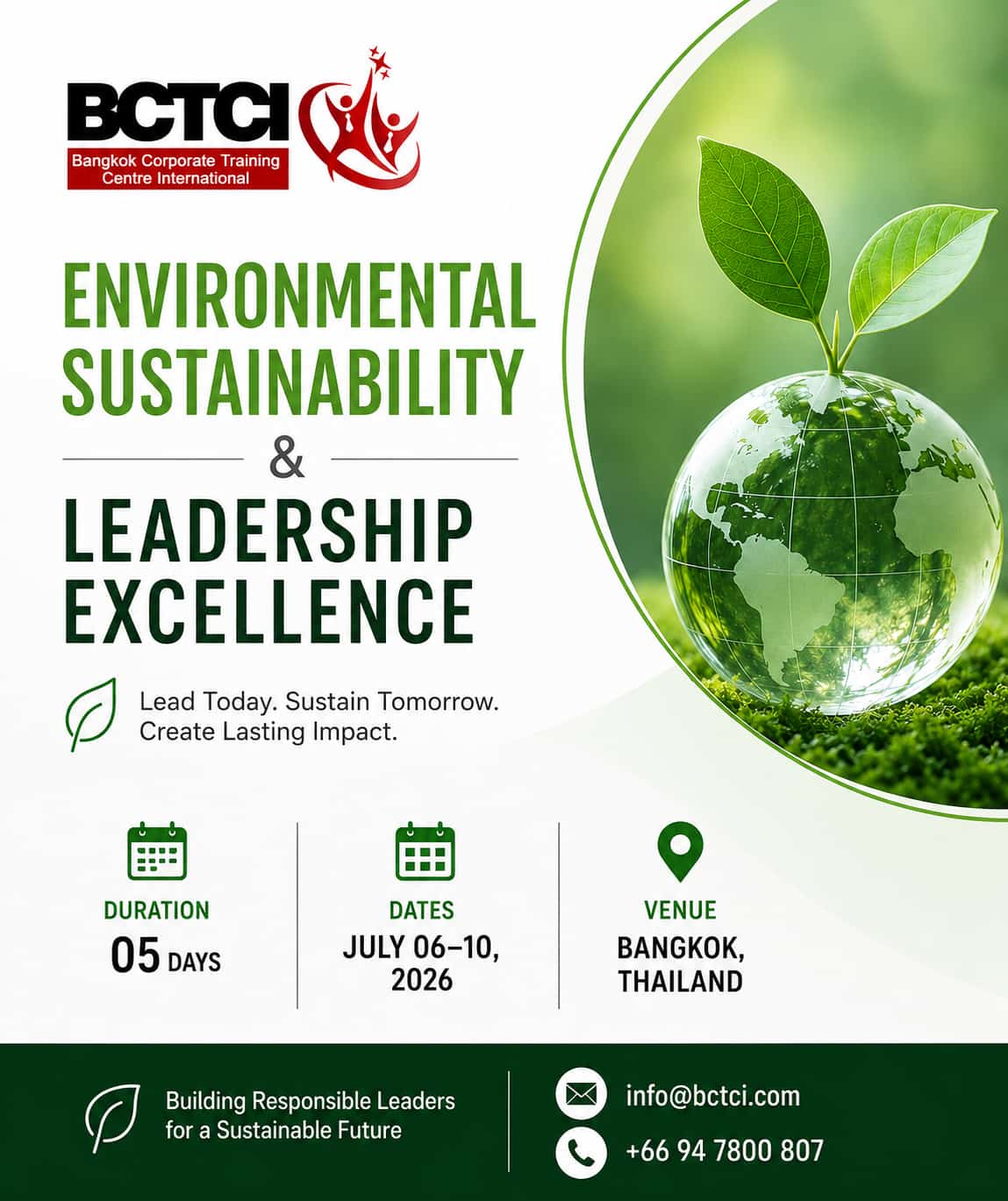
Environmental Sustainability & Leadership Excellence |
|
Duration |
05 Days |
|
Date |
July 06-10,2026 |
|
Venue |
Bangkok, Thailand |
|
Investment |
1,890 USD |
|
|
|
|
|
+66 94 7800 807 |
Course Overview
This 5-day program is designed for managers, executives, public sector leaders, project professionals, sustainability officers, and decision-makers who want to strengthen their environmental leadership capacity. The course combines sustainability strategy, climate-conscious decision-making, ESG thinking, resource efficiency, stakeholder engagement, and leadership excellence to help participants lead responsible, resilient, and future-ready organizations.
Course Objectives
By the end of this course, participants will be able to:
- Understand the core principles of environmental sustainability and sustainable development.
- Link sustainability goals with organizational strategy, governance, and leadership.
- Strengthen leadership skills for driving environmental responsibility across teams.
- Identify environmental risks, impacts, and opportunities within operations.
- Apply ESG, climate resilience, circular economy, and green innovation concepts.
- Improve decision-making for sustainable resource management.
- Build stakeholder engagement strategies for sustainability initiatives.
- Develop practical sustainability action plans for organizational implementation.
- Promote ethical, accountable, and environmentally responsible leadership.
- Measure, monitor, and communicate sustainability performance effectively.
Course Outline
Foundations of Environmental Sustainability and Responsible Leadership
Module 1: Introduction to Environmental Sustainability
- Meaning and scope of environmental sustainability
- Global sustainability challenges and opportunities
- Sustainability in public, private, and development sectors
- Environmental responsibility as a leadership priority
Module 2: Sustainable Development and Organizational Responsibility
- Sustainable development principles
- Balancing economic, social, and environmental priorities
- Organizational accountability for environmental impacts
- Long-term value creation through sustainability
Module 3: Environmental Leadership Mindset
- Characteristics of sustainability-focused leaders
- Leading with purpose, ethics, and accountability
- From compliance mindset to impact mindset
- Building personal commitment to environmental excellence
Module 4: Environmental Risks and Business Continuity
- Climate, pollution, waste, water, and resource risks
- Environmental risk mapping
- Operational disruption and reputational risks
- Risk-based sustainability decision-making
Module 5: Sustainability Governance and Leadership Structures
- Roles of boards, executives, managers, and teams
- Sustainability committees and reporting lines
- Policies, standards, and internal controls
- Embedding sustainability into governance systems
Strategy, ESG, and Sustainable Organizational Performance
Module 6: Building an Environmental Sustainability Strategy
- Setting sustainability vision and priorities
- Aligning sustainability with corporate strategy
- Identifying strategic sustainability objectives
- Developing practical implementation roadmaps
Module 7: ESG Fundamentals for Leaders
- Understanding Environmental, Social, and Governance concepts
- Environmental indicators in ESG performance
- ESG expectations from stakeholders, investors, and partners
- Integrating ESG into management decisions
Module 8: Environmental Compliance and Ethical Responsibility
- Environmental laws, policies, and regulatory expectations
- Compliance vs. voluntary leadership initiatives
- Ethical decision-making in environmental management
- Preventing greenwashing and misleading claims
Module 9: Sustainability Performance Indicators
- Defining measurable sustainability goals
- Key environmental indicators: energy, water, waste, emissions
- Data collection and performance tracking
- Using dashboards for leadership decision-making
Module 10: Sustainable Procurement and Supply Chain Responsibility
- Green procurement principles
- Supplier environmental assessment
- Sustainable sourcing and lifecycle thinking
- Reducing environmental impact across the supply chain
Climate Action, Resource Efficiency, and Circular Economy
Module 11: Climate Change and Organizational Resilience
- Climate change impacts on organizations and communities
- Adaptation and mitigation strategies
- Climate risk assessment
- Building climate-resilient operations
Module 12: Energy Efficiency and Carbon Reduction
- Energy management fundamentals
- Carbon footprint awareness
- Practical energy-saving initiatives
- Leadership role in carbon reduction programs
Module 13: Water Stewardship and Resource Conservation
- Sustainable water management
- Reducing water waste in operations
- Water risk and community responsibility
- Conservation planning and monitoring
Module 14: Waste Management and Pollution Prevention
- Waste hierarchy: reduce, reuse, recycle, recover
- Pollution prevention strategies
- Hazardous and non-hazardous waste management
- Developing workplace waste reduction programs
Module 15: Circular Economy and Green Innovation
- Circular economy principles
- Moving from linear to circular business models
- Product lifecycle and resource recovery
- Innovation for sustainable operations
Leadership Excellence for Sustainability Transformation
Module 16: Leading Sustainability Change
- Change leadership principles
- Overcoming resistance to sustainability initiatives
- Creating urgency and ownership
- Sustaining momentum across departments
Module 17: Stakeholder Engagement and Communication
- Identifying internal and external stakeholders
- Engaging communities, regulators, clients, and employees
- Communicating sustainability goals clearly
- Building trust through transparency
Module 18: Building Sustainable Workplace Culture
- Encouraging employee participation
- Green teams and sustainability champions
- Behavior change in daily operations
- Recognition and accountability mechanisms
Module 19: Decision-Making for Environmental Leadership
- Balancing cost, impact, and responsibility
- Scenario-based decision-making
- Managing trade-offs and competing priorities
- Applying sustainability criteria to leadership decisions
Module 20: Collaboration, Partnerships, and Collective Impact
- Working with government, NGOs, communities, and suppliers
- Public-private sustainability partnerships
- Shared responsibility models
- Designing collaborative environmental initiatives
Sustainability Reporting, Action Planning, and Leadership Excellence
Module 21: Sustainability Reporting and Transparency
- Purpose of sustainability reporting
- Reporting environmental performance
- Communicating progress and challenges
- Avoiding overstatement and greenwashing
Module 22: Monitoring, Evaluation, and Continuous Improvement
- Sustainability monitoring systems
- Reviewing targets and performance gaps
- Corrective action planning
- Continuous improvement cycles
Module 23: Crisis Leadership and Environmental Accountability
- Responding to environmental incidents
- Leadership during public concern or reputational risk
- Accountability and corrective communication
- Learning from incidents and strengthening systems
Module 24: Developing an Organizational Sustainability Action Plan
- Identifying priority areas for action
- Setting SMART sustainability objectives
- Assigning responsibilities and timelines
- Designing practical short-, medium-, and long-term actions
Module 25: Leadership Commitment and Final Presentations
- Participant action plan presentations
- Peer review and trainer feedback
- Personal leadership commitment
- Course reflection and implementation priorities
Training Methodologies
The program will use a practical, interactive, and leadership-focused approach, including:
- Expert-led presentations to explain sustainability and leadership concepts clearly.
- Case studies from public sector, corporate, development, and infrastructure environments.
- Group discussions to encourage exchange of experience among participants.
- Practical exercises on risk mapping, sustainability indicators, and action planning.
- Scenario-based learning for environmental decision-making and crisis leadership.
- Leadership reflection activities to connect personal leadership behavior with sustainability goals.
- Group work and presentations to strengthen communication and implementation skills.
- Sustainability action planning workshop to help participants apply learning directly to their organizations.
- Peer learning through sharing challenges, solutions, and sector-specific practices.
- Trainer feedback and coaching throughout the program.
Course Essentials
Participants will gain essential knowledge and tools in:
- Environmental sustainability principles
- ESG and responsible governance
- Climate resilience and environmental risk management
- Energy, water, waste, and resource efficiency
- Circular economy and green innovation
- Sustainable procurement and supply chain responsibility
- Sustainability performance indicators
- Stakeholder engagement and sustainability communication
- Environmental leadership and change management
- Sustainability reporting and transparency
- Action planning for organizational implementation
Main Takeaways
At the end of the 5-day course, participants will be able to:
- Lead sustainability initiatives with confidence and strategic clarity.
- Understand how environmental sustainability supports organizational resilience.
- Identify environmental risks and convert them into improvement opportunities.
- Apply ESG and sustainability principles in leadership decision-making.
- Strengthen resource efficiency through better energy, water, and waste practices.
- Build a sustainability-focused workplace culture.
- Communicate sustainability goals and progress more effectively.
- Engage stakeholders with transparency and credibility.
- Develop practical sustainability action plans for their organization.
- Demonstrate leadership excellence through ethical, responsible, and future-ready environmental management.