
|
Course |
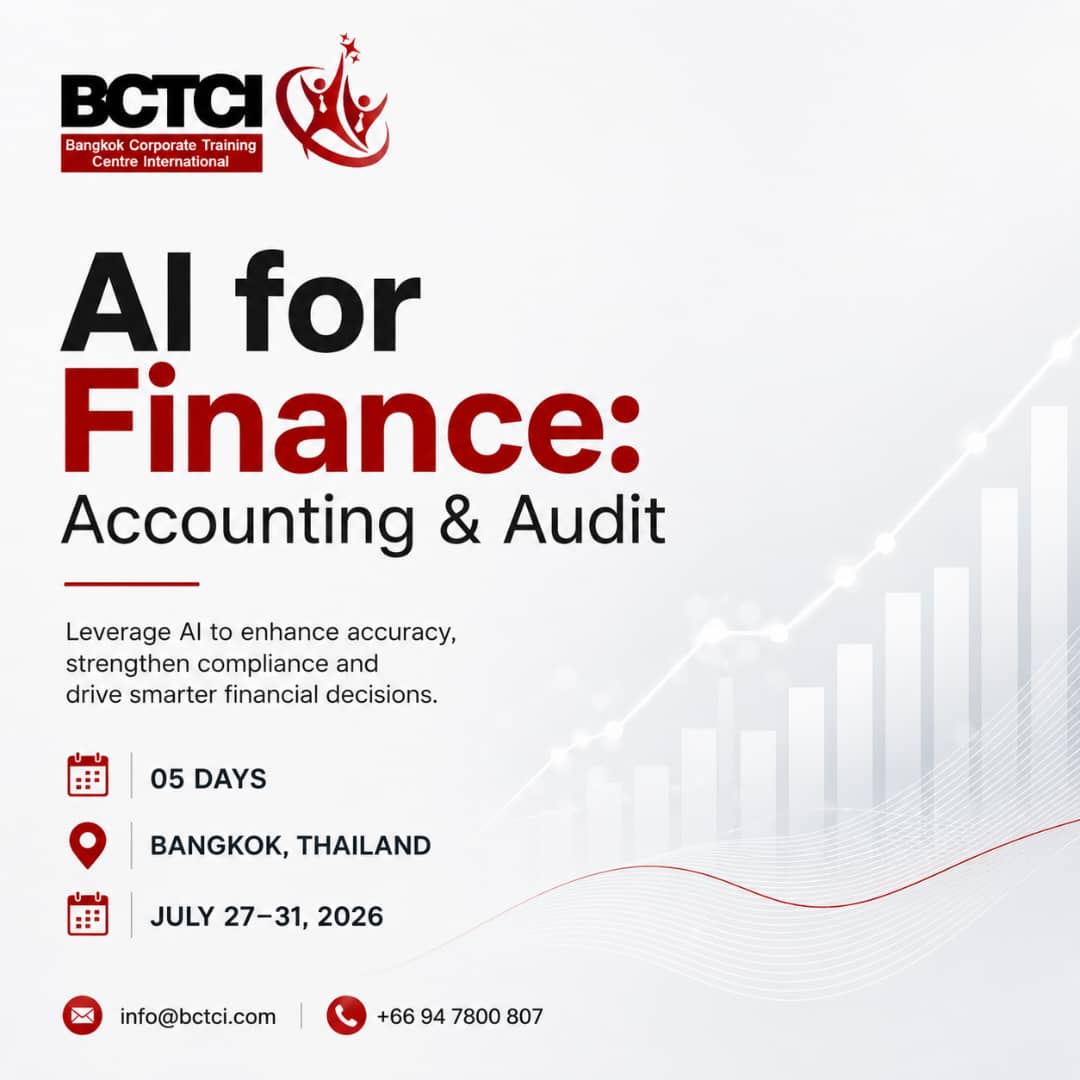
AI for Finance, Accounting & Audit |
|
Duration |
05 Days |
|
Date |
July 27-31, 2026 |
|
Venue |
Bangkok, Thailand |
|
Investment |
2,190 USD |
|
|
|
|
|
+66 94 7800 807 |
Course Overview
This 05-day professional training program is designed to help finance, accounting, and audit professionals understand how Artificial Intelligence, automation, data analytics, and digital tools are transforming financial operations, reporting, control, audit planning, fraud detection, compliance, and strategic decision-making.
The course provides a practical and business-focused approach to using AI tools in finance functions, accounting processes, audit activities, risk assessment, financial analysis, forecasting, internal controls, and management reporting. Participants will learn how to identify AI use cases, apply AI-supported analytics, improve efficiency, strengthen controls, and manage risks related to AI adoption.
Course Objectives
By the end of this course, participants will be able to:
- Understand the role of AI in modern finance, accounting, and audit functions.
- Identify practical AI use cases for financial analysis, reporting, accounting, budgeting, and audit.
- Apply AI tools to improve financial data analysis and decision-making.
- Use AI-supported techniques for forecasting, budgeting, variance analysis, and management reporting.
- Understand automation opportunities in accounts payable, accounts receivable, reconciliation, and month-end closing.
- Strengthen audit planning, risk assessment, and audit testing through data analytics and AI.
- Detect anomalies, red flags, and potential fraud indicators using AI-enabled methods.
- Improve internal control monitoring through continuous auditing and automated alerts.
- Understand AI risks, limitations, governance requirements, and ethical considerations.
- Develop a practical roadmap for implementing AI in finance, accounting, and audit departments.
Personal and Organizational Impacts
Personal Impacts
Participants will be able to:
- Improve their confidence in using AI and analytics tools in finance-related work.
- Strengthen analytical thinking and data-driven decision-making skills.
- Reduce time spent on repetitive finance, accounting, and audit tasks.
- Improve their ability to interpret financial data and identify unusual patterns.
- Communicate AI-supported financial insights clearly to management.
- Build future-ready skills for digital finance and audit transformation.
- Improve audit quality, financial reporting accuracy, and professional productivity.
Organizational Impacts:
Organizations will benefit through:
- Increased efficiency in finance and accounting operations.
- Improved accuracy and timeliness of financial reporting.
- Stronger forecasting, budgeting, and financial planning capabilities.
- Improved audit coverage and risk-based audit planning.
- Better fraud detection, anomaly identification, and control monitoring.
- Reduced manual errors and repetitive processing.
- Enhanced financial transparency, compliance, and accountability.
- Improved decision-making through AI-supported insights.
- Stronger readiness for digital transformation in finance and audit.
- Better governance and responsible adoption of AI tools.
Main Course Takeaways
Participants will take away:
- A clear understanding of AI applications in finance, accounting, and audit.
- Practical knowledge of AI-supported financial analysis and reporting.
- Techniques for automating finance and accounting processes.
- Understanding of AI in budgeting, forecasting, and variance analysis.
- Knowledge of AI-enabled audit planning, testing, and evidence analysis.
- Practical approaches to anomaly detection and fraud risk identification.
- Tools for continuous auditing and internal control monitoring.
- Awareness of AI governance, data privacy, ethics, and compliance issues.
- Practical templates for AI use case identification and implementation planning.
- A structured roadmap for applying AI in finance, accounting, and audit functions.
Course Essentials
This course will cover essential knowledge and practical applications in:
- AI fundamentals for finance professionals.
- Data analytics for finance, accounting, and audit.
- AI tools for financial reporting and decision support.
- Automation of accounting workflows.
- AI-supported budgeting, forecasting, and planning.
- Financial statement analysis using AI.
- Audit analytics and risk-based audit planning.
- Continuous auditing and control monitoring.
- Fraud detection and anomaly identification.
- AI in compliance, governance, and regulatory reporting.
- Responsible AI, ethics, data protection, and cybersecurity considerations.
- AI implementation planning for finance and audit departments.
Training Methdologies:
The course will be delivered through a highly practical, interactive, and business-focused approach, including:
- Instructor-Led Presentations
Clear explanation of AI concepts, finance applications, accounting automation, audit analytics, and governance requirements. - Practical Demonstrations
Demonstrations of AI-supported analysis, reporting, forecasting, reconciliation, audit planning, and anomaly detection. - Case Studies
Realistic examples from finance departments, accounting teams, audit units, banks, public institutions, NGOs, and corporate organizations. - Group Exercises
Participants will analyze AI use cases, review financial data scenarios, assess audit risks, and design improvement actions. - Scenario-Based Learning
Practical scenarios on financial forecasting, suspicious transactions, audit exceptions, control gaps, and reporting automation. - Templates and Checklists
Participants will receive practical tools for AI use case selection, data readiness assessment, finance automation mapping, and audit analytics planning. - Interactive Discussions
Facilitated discussions on AI opportunities, risks, limitations, ethics, and implementation challenges. - Capstone Workshop
Participants will prepare a practical AI adoption roadmap for finance, accounting, or audit functions within their organization.
Course Outline:
Foundations of AI in Finance, Accounting and Audit
Module 1: Introduction to AI in Finance, Accounting and Audit
- What AI means for finance, accounting, and audit professionals.
- Difference between AI, automation, machine learning, and analytics.
- Why finance and audit functions are adopting AI.
- Benefits, risks, and limitations of AI tools.
- Key transformation areas in finance, accounting, and audit.
Module 2: Digital Finance Transformation
- Evolution from manual finance to digital finance.
- Role of cloud systems, ERP, automation, and analytics.
- Digital finance operating models.
- Finance function maturity assessment.
- Preparing finance teams for AI adoption.
Module 3: Data Foundations for AI
- Importance of clean and reliable financial data.
- Structured and unstructured financial data.
- Data sources: ERP, accounting systems, bank records, invoices, audit files, and reports.
- Common data quality issues in finance and audit.
- Data preparation for AI-supported analysis.
Module 4: AI Tools and Technologies for Finance Professionals
- Generative AI tools for finance and audit support.
- Spreadsheet-based AI and automation tools.
- Business intelligence and dashboarding platforms.
- Robotic process automation and workflow automation.
- Selecting the right AI tool for finance, accounting, and audit tasks.
Module 5: AI Use Case Identification
- Identifying repetitive and high-value finance tasks.
- Prioritizing use cases by impact and feasibility.
- Mapping AI opportunities in accounting, reporting, budgeting, and audit.
- Assessing cost, risk, and data readiness.
- Building an AI use case register.
AI in Financial Analysis, Planning and Reporting
Module 6: AI-Supported Financial Statement Analysis
- Analyzing balance sheets, income statements, and cash flow statements.
- Ratio analysis using AI-supported tools.
- Trend and variance identification.
- Benchmarking financial performance.
- Preparing management insights from financial data.
Module 7: AI in Budgeting and Forecasting
- Role of AI in budgeting and planning.
- Revenue and expense forecasting.
- Cash flow forecasting.
- Scenario planning and sensitivity analysis.
- Improving forecast accuracy through data-driven models.
Module 8: AI for Variance Analysis and Performance Monitoring
- Budget vs actual analysis.
- Revenue, cost, and margin variance.
- Identifying root causes of variances.
- Automated variance explanations.
- Preparing corrective action recommendations.
Module 9: AI in Management Reporting
- Automating monthly and quarterly financial reports.
- Creating executive summaries from financial data.
- Visual reporting and dashboards.
- Generating narrative insights from numbers.
- Improving report clarity and decision usefulness.
Module 10: AI for Strategic Financial Decision-Making
- AI-supported investment analysis.
- Cost optimization opportunities.
- Profitability and product/service analysis.
- Financial risk indicators.
- Using AI insights for strategic management decisions.
AI in Accounting Operations and Process Automation
Module 11: AI in Accounts Payable
- Invoice capture and document reading.
- Invoice matching and approval workflows.
- Duplicate invoice detection.
- Payment scheduling and exception handling.
- Controls in automated accounts payable processes.
Module 12: AI in Accounts Receivable and Collections
- Customer payment behavior analysis.
- Receivables aging and collection prioritization.
- Credit risk monitoring.
- Automated reminders and communication support.
- Improving cash collection through analytics.
Module 13: AI in Bank Reconciliation and Month-End Closing
- Automated transaction matching.
- Identifying unmatched and unusual transactions.
- Reducing manual reconciliation effort.
- Month-end closing workflow automation.
- Close process monitoring and exception reporting.
Module 14: AI in Payroll, Expenses and Cost Control
- Payroll data validation.
- Expense claim analysis.
- Detecting duplicate or unusual claims.
- Departmental cost monitoring.
- Strengthening approval and compliance controls.
Module 15: Accounting Automation Risks and Controls
- Risks of automated accounting processes.
- Control design for AI-assisted accounting.
- Segregation of duties in digital workflows.
- Approval, audit trail, and exception controls.
- Monitoring automation accuracy and reliability.
AI in Audit, Risk and Compliance
Module 16: AI in Internal Audit and External Audit
- How AI changes audit planning and execution.
- Audit analytics and full-population testing.
- Automated audit procedures.
- Evidence gathering and documentation.
- Role of professional judgment in AI-assisted audit.
Module 17: AI-Enabled Risk Assessment
- Risk identification using financial and operational data.
- Risk scoring and prioritization.
- Identifying high-risk transactions and processes.
- Using AI to support audit planning.
- Linking risk assessment with audit programs.
Module 18: Fraud Detection and Anomaly Identification
- Common financial fraud red flags.
- Duplicate payments and unusual transactions.
- Vendor, employee, and customer-related anomalies.
- Pattern detection using AI-supported analytics.
- Investigating exceptions and false positives.
Module 19: Continuous Auditing and Continuous Monitoring
- Difference between periodic audit and continuous audit.
- Automated control testing.
- Exception dashboards and alerts.
- Continuous monitoring of key controls.
- Reporting issues to management and audit committees.
Module 20: AI in Compliance and Regulatory Reporting
- Compliance monitoring using AI.
- Regulatory reporting support.
- Policy compliance testing.
- Documentation and audit trail requirements.
- Reducing compliance gaps through automation.
Governance, Ethics, Implementation and Capstone
Module 21: AI Governance for Finance, Accounting and Audit
- AI governance principles.
- Roles and responsibilities in AI adoption.
- Model validation and human oversight.
- Approval processes for AI tools.
- Documentation and accountability.
Module 22: Data Privacy, Security and Ethical AI
- Financial data privacy considerations.
- Cybersecurity risks in AI-supported systems.
- Bias, transparency, and explainability.
- Ethical use of AI-generated outputs.
- Responsible AI policy for finance and audit teams.
Module 23: Managing AI Implementation Projects
- Building the business case for AI adoption.
- Selecting pilot projects.
- Stakeholder engagement and change management.
- Measuring benefits and return on investment.
- Scaling AI solutions across finance and audit functions.
Module 24: Practical AI Roadmap for Finance and Audit Functions
- Assessing current finance and audit maturity.
- Identifying priority AI opportunities.
- Data readiness and system readiness checklist.
- Implementation timeline and resource planning.
- Risk controls and success indicators.
Module 25: Capstone Workshop: AI Use Case Design and Action Plan
- Group exercise on AI use cases in finance, accounting, and audit.
- Designing an AI-supported finance or audit improvement project.
- Preparing implementation steps and expected benefits.
- Presenting action plans and receiving trainer feedback.
- Individual workplace application planning.